The Japan Cup (G1) is run in Tokyo early on Sunday morning European time, and the field has rarely been stronger. Last year’s winner Calandagan is back to defend his title, and he is joined by five other overseas challengers – among them Ombudsman, who will end his career in Japan.
The Japan Cup (G1) is run over 2,400 metres on turf, with the off at 15.40 local time, which is 07.40 Danish time (06.40 in the UK). The first prize is 500 million yen – only the Arima Kinen at the end of December can match that in Japan – and even the 10th-placed horse takes home ten million yen.
Eighteen horses go to post, and according to the Japan Racing Association a record 11 of them have won at the highest level. Six come from overseas, the largest number of foreign runners since 2010. By comparison, Calandagan was the only overseas runner last year, and in 2019 there were none at all.
Calandagan bids to do the – almost – impossible

Calandagan (Gleneagles) wrote himself into the history books last year when he became the first overseas-trained horse in 20 years to win the Japan Cup. He even did it in a record time of 2:20.3, holding off Masquerade Ball by a head. The five-year-old gelding is trained by Francis-Henri Graffard for Aga Khan Studs and now has six Group 1 wins to his name.
This year he has won the Dubai Sheema Classic and, for the second time, the Grand Prix de Saint-Cloud, while finishing second in both the King George VI and Queen Elizabeth Stakes and the Champion Stakes. No overseas horse has ever won the Japan Cup twice, and Graffard makes no secret of how hard the task is: “It’s very good for the racing fans to see him again this year and try to do something that is nearly impossible to do. But he’s a champion, and I’m very pleased with his condition”, he said at the JRA press conference on Thursday.
Graffard is in top form. In October he won the Prix de l’Arc de Triomphe for the second year running with Daryz, and last Sunday Mickael Barzalona won the Mile Championship (G1) at Kyoto on the Graffard-trained Erdenali. Barzalona keeps the ride on Calandagan, who is drawn in stall 9.
The biggest threat may come from the stall right next door, number 8. That is where Godolphin’s Ombudsman (Night Of Thunder) starts, the winner of 10 of his 14 starts and four of five this year – the Dubai Turf, the Prince of Wales’s Stakes, the International Stakes and the Champion Stakes, where he beat none other than Calandagan by nearly four lengths. With a rating of 131, the five-year-old is the world’s second-highest rated racehorse behind Hong Kong’s Ka Ying Rising.
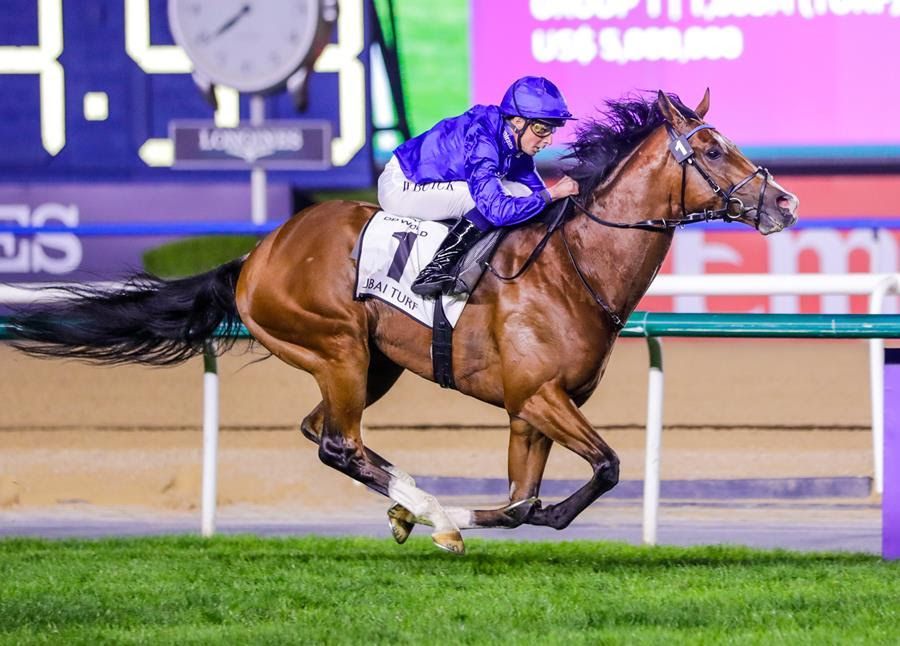
The Japan Cup will be his final race before he retires to stud, and one big question hangs over him: Ombudsman has never raced over 2,400 metres, and he has never faced a field of 18. He is nevertheless favourite with the British bookmakers, while the Japanese forecasts point to Calandagan. Godolphin’s blue silks have never won the Japan Cup, even though Sheikh Mohammed has had runners in the race since 1983.
Aidan O’Brien sends Minnie Hauk (Frankel) to Tokyo with Ryan Moore in the saddle. The four-year-old filly won the Oaks, the Irish Oaks and the Yorkshire Oaks last year and has added the British Champions Fillies & Mares Stakes to her collection this year. As the only filly in the field, she carries 56 kilos against the others’ 58. O’Brien has never won the Japan Cup – his best result is Idaho‘s fifth place in 2017.
Graffard also runs Goliath (Adlerflug). The six-year-old gelding won the King George in 2024, finished sixth in the Japan Cup the same year and has won the Preis von Europa in Cologne this year. Christophe Soumillon rides. Willie Mullins, best known for his jumpers, saddles the 2025 Breeders’ Cup Turf winner Ethical Diamond (Awtaad), while South America is represented by the Chilean four-time Group 1 winner Teao (Ya Primo), who is now based with John Sadler in California. His damsire is Seeking the Dia, who also raced in Japan in his day.
Japan’s strong home team
Facing the international challenge are 12 Japanese horses, six of them Group 1 winners. The best fancied is Danon Decile (Epiphaneia), who won the autumn Tenno Sho over 2,000 metres at the same track on 1 November – his third Group 1 success. The five-year-old won the Japanese Derby in 2024 and beat Calandagan in the 2025 Dubai Sheema Classic, but could only finish fifth behind Ombudsman in the International Stakes at York in August. Last year he was third in the Japan Cup. He starts from stall 16.
Croix du Nord (Kitasan Black) won the Japanese Derby in 2025 and has this year landed both the Osaka Hai over 2,000 metres and the spring Tenno Sho over 3,200 metres. He was favourite for the autumn Tenno Sho but started from the innermost stall and never got a clear run, finishing fifth. Last year he was fourth in the Japan Cup, and this time he breaks from stall 4 under Cristian Demuro.
Masquerade Ball (Duramente) was only a head away from winning last year and won the autumn Tenno Sho in 2025. This year he has, among other things, finished second to Romantic Warrior in the Queen Elizabeth II Cup in Hong Kong, but he disappointed in the Tenno Sho, finishing only 11th as second favourite. Christophe Lemaire rides from stall 6.
Japanese jockey legend Yutaka Take rides Meisho Tabaru (Gold Ship), who won the Takarazuka Kinen for the second year running in June. He finished 14th in the Prix de l’Arc de Triomphe in October, and 2,400 metres looks to be at the limit of his range.
From Mairzy Doates to Calandagan
The Japan Cup was first run in 1981. The Japan Racing Association created the race to raise the standard of Japanese racing by letting the local horses take on the world’s best, and in the early years it was the visitors who dominated. The first running was won by the American horse Mairzy Doates with Cash Asmussen in the saddle, and the following year there was another American winner, Half Iced.
In 1983 came the first European success when the Irish mare Stanerra won for trainer Frank Dunne. Only the following year did the Japanese get their first winner with Katsuragi Ace, and in 1985 the legendary Symboli Rudolf followed up.
Europeans have won nine times in all. After Stanerra came Jupiter Island (1986) for Clive Brittain and Pat Eddery and Le Glorieux (1987), who was trained by none other than Robert Collet – the French trainer whose record for the most quinté wins in a single season on the Flat Pia and Joakim Brandt have equalled this year. Later came the German-trained Lando (1995), Michael Stoute’s Singspiel (1996) and Pilsudski (1997), the Italian-trained Falbrav (2002) and Luca Cumani’s Alkaased (2005). Frankie Dettori rode three of them: Singspiel, Falbrav and Alkaased. Falbrav‘s win, incidentally, came at Nakayama over 2,200 metres, because Tokyo was being rebuilt.
After that the picture changed. Japanese horses got better and better, and the number of overseas runners fell. From 2006 to 2024 Japanese horses won 19 times in a row, and in 2019 not a single overseas horse took part. Deep Impact, Gentildonna, Almond Eye and Equinox are among the winners, and Gentildonna (2012 and 2013) and Almond Eye (2018 and 2020) are the only horses to have won the race twice. Almond Eye‘s winning time of 2:20.6 in 2018 was a world record for the distance until Calandagan shaved a further three tenths off it last year.
According to the JRA, Calandagan‘s win has encouraged more overseas trainers to have a go, and that is reflected in this year’s field. On Sunday he can become the first overseas horse to win the Japan Cup twice – and join Gentildonna and Almond Eye.